Quadratische Gleichungen lösen

Die Mitternachtsformel

Lisa von OnMathe
Aktualisiert am
November 9, 2026
two students high five

Auf einen Blick

Was ist die Mitternachtsformel?

Die Mitternachtsformel ist eine allgemeine Lösungsformel, mit der du quadratische Gleichungen lösen kannst.

Wenn die Gleichung in der allgemeinen Form steht, kannst du direkt einsetzen.

Beispiel
\( {\textcolor{orangered}{2}}x^2 \; {\textcolor{orange}{-}} \;{\textcolor{orange}{4}}x \; {\textcolor{green}{-}} \; {\textcolor{green}{6}} = 0 \)

\({\textcolor{orangered}{a}}\), \({\textcolor{orange}{b}}\) und \({\textcolor{green}{c}}\) ablesen:

→ \( {\textcolor{orangered}{a}} = {\textcolor{orangered}{2}},\quad {\textcolor{orange}{b}} = {\textcolor{orange}{-4}},\quad {\textcolor{green}{c}} = {\textcolor{green}{-6}} \)

Mitternachtsformel anwenden:

\( x_{1,2} = \dfrac{-{\textcolor{orange}{b}} \pm \sqrt{{\textcolor{orange}{b}}^2 - 4 \cdot {\textcolor{orangered}{a}} \cdot {\textcolor{green}{c}}}} {2 \cdot {\textcolor{orangered}{a}}} \)
\( x_{1,2} = \dfrac{-({\textcolor{orange}{-4}}) \pm \sqrt{({\textcolor{orange}{-4}})^2 - 4 \cdot {\textcolor{orangered}{2}} \cdot ({\textcolor{green}{-6}})}} {2 \cdot {\textcolor{orangered}{2}}} \)
\( x_1 = 3 \quad \text{und} \quad x_2 = -1 \)

Im Beitrag lernst du jeden Schritt verständlich kennen – inklusive Sonderfällen, typischen Fehlern und Übungsaufgaben.

Merke
\( 0 = {\textcolor{orangered}{a}}x^2 + {\textcolor{orange}{b}}x + {\textcolor{green}{c}} \)
\( x_{1,2} = \dfrac{-{\textcolor{orange}{b}} \pm \sqrt{{\textcolor{orange}{b}}^2 - 4 \cdot {\textcolor{orangered}{a}} \cdot {\textcolor{green}{c}}}} {2 \cdot {\textcolor{orangered}{a}}} \)

Du willst deine eigene Gleichung lösen? Unser Mitternachtsformel-Rechner zeigt dir jeden Schritt.

Beispiel: zwei Lösungen

Wir schauen uns an einem Beispiel Schritt für Schritt an, wie man die Mitternachtsformel anwendet.

Beispiel
\( {\textcolor{orangered}{2}}x^2 \;{\textcolor{orange}{-}}\; {\textcolor{orange}{3}}x \;{\textcolor{green}{-}}\; {\textcolor{green}{5}} = 0 \)

Die Gleichung ist schon in der allgemeinen Form. So kannst du \({\textcolor{orangered}{a}}\), \({\textcolor{orange}{b}}\) und \({\textcolor{green}{c}}\) direkt ablesen.

\( {\textcolor{orangered}{2}}x^2 \;{\textcolor{orange}{-}}\; {\textcolor{orange}{3}}x \;{\textcolor{green}{-}}\; {\textcolor{green}{5}} = 0 \)
\( {\textcolor{orangered}{a}} = {\textcolor{orangered}{2}} \quad {\textcolor{orange}{b}} = {\textcolor{orange}{-3}} \quad {\textcolor{green}{c}} = {\textcolor{green}{-5}} \)
Wichtig

Achte beim Ablesen genau auf die Vorzeichen!

\( {\textcolor{orange}{b}} = {\textcolor{orange}{-3}} \quad \Rightarrow \quad \text{nicht } \quad {\textcolor{orangered}{b = 3}} \)
\( {\textcolor{green}{c}} = {\textcolor{green}{-5}} \quad \Rightarrow \quad \text{nicht } \quad {\textcolor{orangered}{c = 5}} \)
\( ({\textcolor{orange}{-3}})^2 = 9 \quad \) (nur mit Klammer richtig)

Jetzt setzen wir unsere Werte in die Mitternachtsformel ein...

\( x_{1,2} = \dfrac{ -{\textcolor{orange}{b}} \pm \sqrt{ {\textcolor{orange}{b}}^2 - 4 \cdot {\textcolor{orangered}{a}} \cdot {\textcolor{green}{c}} } } { 2 \cdot {\textcolor{orangered}{a}} } \)
\( {\textcolor{orangered}{a}} = {\textcolor{orangered}{2}} \quad {\textcolor{orange}{b}} = {\textcolor{orange}{-3}} \quad {\textcolor{green}{c}} = {\textcolor{green}{-5}} \)
\( x_{1,2} = \dfrac{ -({\textcolor{orange}{-3}}) \pm \sqrt{ ({\textcolor{orange}{-3}})^2 - 4 \cdot {\textcolor{orangered}{2}} \cdot ({\textcolor{green}{-5}}) } } { 2 \cdot {\textcolor{orangered}{2}} } \)

...und fassen den Term unter der Wurzel zusammen.

\( x_{1,2} = \dfrac{3 \pm \sqrt{9 + 40}}{4} \)
\( x_{1,2} = \dfrac{3 \pm \sqrt{49}}{4} \)

Am Ende trennen wir \( x_1 \) und \( x_2 \):

\( x_1 = \dfrac{3 {\textcolor{green}{+}} \sqrt{49}}{4} \hspace{3em} x_2 = \dfrac{3 {\textcolor{orangered}{-}} \sqrt{49}}{4} \)
\( x_1 = \dfrac{3 + 7}{4} \hspace{3em} x_2 = \dfrac{3 - 7}{4} \)
\( {\textcolor{green}{x_1}} = 2{,}5 \hspace{3em} {\textcolor{orangered}{x_2}} = -1 \)

Die Lösungen der quadratischen Gleichung sind gleichzeitig die Nullstellen der Funktion:

\( {\textcolor{green}{N_1}}(2{,}5 \mid 0) \hspace{3em} {\textcolor{orangered}{N_2}}(-1 \mid 0) \)

Selbst ausprobieren

Mitternachtsformel-Rechner

Probier es selbst aus – gib deine Werte für a, b und c ein und sieh dir Schritt für Schritt an, wie die Mitternachtsformel angewendet wird.


Rechner
a b c
Beispiele: 2, -3, -5 1, -2, 1 1, 0, -4 1, 2, 5


Gib a, b und c ein und klicke auf Berechnen.

Wo du dich hier verrechnest, sieht dein Tutor sofort. Er gehört zu den besten im deutschsprachigen Raum.

Kostenlos testen: Online Nachhilfe Mathe bei OnMathe

Beispiel: keine Lösung

Das nächste Beispiel zeigt uns den ersten Sonderfall.

Beispiel
\( x^2 + 2x + 5 = 0 \)

Wir lesen wieder die Werte für \({\textcolor{orangered}{a}}\), \({\textcolor{orange}{b}}\) und \({\textcolor{green}{c}}\) ab. Wir zeigen dir auch, was vor dem \(x^2\) steht.

\( {\textcolor{orangered}{1}} x^2 + {\textcolor{orange}{2}} x + {\textcolor{green}{5}} = 0 \)
\( {\textcolor{orangered}{a}} = {\textcolor{orangered}{1}} \quad {\textcolor{orange}{b}} = {\textcolor{orange}{2}} \quad {\textcolor{green}{c}} = {\textcolor{green}{5}} \)
Wichtig

Wenn vor \(x^2\) oder \(x\) scheinbar keine Zahl steht,
steht dort immer eine 1.

Jetzt wenden wir die Mitternachtsformel an und fassen zusammen.

\( x_{1,2} = \dfrac{-{\textcolor{orange}{b}} \pm \sqrt{{\textcolor{orange}{b}}^2 - 4 \cdot {\textcolor{orangered}{a}} \cdot {\textcolor{green}{c}}}} {2 \cdot {\textcolor{orangered}{a}}} \)
\( {\textcolor{orangered}{a}} = {\textcolor{orangered}{1}} \quad {\textcolor{orange}{b}} = {\textcolor{orange}{2}} \quad {\textcolor{green}{c}} = {\textcolor{green}{5}} \)
\( x_{1,2} = \dfrac{-{\textcolor{orange}{2}} \pm \sqrt{{\textcolor{orange}{2}}^2 - 4 \cdot {\textcolor{orangered}{1}} \cdot {\textcolor{green}{5}} }} {2 \cdot {\textcolor{orangered}{1}}} \)
\( x_{1,2} = \dfrac{-2 \pm \sqrt{4 - 20}}{2} \)
\( x_{1,2} = \dfrac{-2 \pm \sqrt{ {\textcolor{orangered}{-16}} }}{2} \)

Hier endet unsere Rechnung, da unter der Wurzel eine negative Zahl steht.

Ergebnis

Unter der Wurzel steht eine negative Zahl → es gibt keine Lösungen – die Funktion besitzt also keine Nullstellen.

Beispiel: eine Lösung

Du kennst nun schon einen Sonderfall – aber es gibt noch einen zweiten.

Beispiel
\( x^2 - 6x + 9 = 0\)

Zuerst lesen wir wieder die Werte für \({\textcolor{orangered}{a}}\), \({\textcolor{orange}{b}}\) und \({\textcolor{green}{c}}\) heraus. Wie zuvor steht vor dem \(x^2\) eine "unsichtbare" \({\textcolor{orangered}{1}}\).

\( {\textcolor{orangered}{1}}x^2 \; {\textcolor{orange}{-}} \; {\textcolor{orange}{6}}x \; {\textcolor{green}{+}} \; {\textcolor{green}{9}} = 0 \)
\( {\textcolor{orangered}{a}} = {\textcolor{orangered}{1}} \quad {\textcolor{orange}{b}} = {\textcolor{orange}{-6}} \quad {\textcolor{green}{c}} = {\textcolor{green}{9}} \)

Jetzt kommt wieder die Mitternachtsformel. Wir setzen die Zahlen ein und rechnen wie gewohnt weiter.

\( x_{1,2} = \dfrac{-{\textcolor{orange}{b}} \pm \sqrt{{\textcolor{orange}{b}}^2 - 4 \cdot {\textcolor{orangered}{a}} \cdot {\textcolor{green}{c}}}} {2 \cdot {\textcolor{orangered}{a}}} \)
\( {\textcolor{orangered}{a}} = {\textcolor{orangered}{1}} \quad {\textcolor{orange}{b}} = {\textcolor{orange}{-6}} \quad {\textcolor{green}{c}} = {\textcolor{green}{9}} \)
\( x_{1,2} = \dfrac{-({\textcolor{orange}{-6}}) \pm \sqrt{({\textcolor{orange}{-6}})^2 - 4 \cdot {\textcolor{orangered}{1}} \cdot {\textcolor{green}{9}}}} {2 \cdot {\textcolor{orangered}{1}}} \)
\( x_{1,2} = \dfrac{6 \pm \sqrt{36 - 36}}{2} \)
\( x_{1,2} = \dfrac{6 \pm \sqrt{\textcolor{orangered}{0}}}{2} \)

Besonderheit: Unter der Wurzel steht eine 0 - es kommt also nichts dazu, es fällt nichts weg. Wir brauchen keine Fallunterscheidung.

\( x_{1,2} = \dfrac{6}{2} \)
\( {\textcolor{green}{x}} = 3 \)

Das bedeutet, die quadratische Funktion hat nur eine Nullstelle.

\( {\textcolor{green}{N}}(3 \mid 0) \)
Wichtig

\(\sqrt{0}\) ändert nichts → es gibt nur eine Lösung und somit nur eine Nullstelle.

Wie viele Lösungen es gibt, siehst du mit deinem Tutor bald schon vor dem Rechnen.

Kostenlos testen bei OnMathe

Exkurs: Diskriminante und Anzahl der Lösungen

Du hast gesehen: Die Anzahl der Lösungen hängt davon ab, was unter der Wurzel steht.

Dieser Teil hat einen Namen. Er heißt Diskriminante und bedeutet: „Die Zahl unter der Wurzel“.

Man kann die Mitternachtsformel deshalb auch so schreiben:

\( x_{1,2} = \dfrac{-b \pm \sqrt{\mathsf{Diskriminante}}}{2a} \)

Die Diskriminante wird mit dem Buchstaben \( D \) abgekürzt:

\( D = {\textcolor{orange}{b}}^2 - 4 \cdot {\textcolor{orangered}{a}} \cdot {\textcolor{green}{c}} \)

Rechnen wir das einmal bei allen drei Beispielen nach:

Beispiel
\( {\textcolor{orangered}{2}}x^2 \;{\textcolor{orange}{-}}\; {\textcolor{orange}{3}}x \;{\textcolor{green}{-}}\; {\textcolor{green}{5}} = 0 \)

Wir lesen \({\textcolor{orangered}{a}}\), \({\textcolor{orange}{b}}\) und \({\textcolor{green}{c}}\) heraus:

\( {\textcolor{orangered}{a = 2}} \quad {\textcolor{orange}{b = -3}} \quad {\textcolor{green}{c = -5}} \)

Und setzen in die Diskriminante ein:

\( D = ({\textcolor{orange}{-3}})^2 - 4 \cdot {\textcolor{orangered}{2}} \cdot ({\textcolor{green}{-5}}) \)
\( D = 49 \)

→ Die Zahl unter der Wurzel ist positiv. Also gibt es zwei Lösungen.

Beispiel
\( x^2 + 2x + 5 = 0 \)

Wir lesen \({\textcolor{orangered}{a}}\), \({\textcolor{orange}{b}}\) und \({\textcolor{green}{c}}\) heraus:

\( {\textcolor{orangered}{a = 1}} \quad {\textcolor{orange}{b = 2}} \quad {\textcolor{green}{c = 5}} \)

Und setzen in die Diskriminante ein:

\( D = {\textcolor{orange}{2}}^2 - 4 \cdot {\textcolor{orangered}{1}} \cdot {\textcolor{green}{5}} \)
\( D = -16 \)

→ Unter der Wurzel steht eine negative Zahl. Das bedeutet: Es gibt keine Lösung.

Beispiel
\( x^2 - 6x + 9 = 0\)

Wir lesen \({\textcolor{orangered}{a}}\), \({\textcolor{orange}{b}}\) und \({\textcolor{green}{c}}\) heraus:

\( {\textcolor{orangered}{a = 1}} \quad {\textcolor{orange}{b = -6}} \quad {\textcolor{green}{c = 9}} \)

Und setzen in die Diskriminante ein:

\( D = ({\textcolor{orange}{-6}})^2 - 4 \cdot {\textcolor{orangered}{1}} \cdot {\textcolor{green}{9}} \)
\( D = 0 \)

→ Die Zahl unter der Wurzel ist genau null. Also gibt es nur eine Lösung.

Merke

Die Diskriminante zeigt dir, wie viele Lösungen eine quadratische Gleichung hat:

\( D > 0 \) → zwei Lösungen
\( D = 0 \) → eine Lösung
\( D < 0 \) → keine Lösung

Am Graphen siehst du das so: Die Lösungen sind die Stellen, an denen die Parabel die x-Achse trifft.

Diskriminante und Anzahl der Lösungen D > 0 D = 0 D < 0 zwei Lösungen eine Lösung keine Lösung

Quadratische Gleichungen? Wir bringen Struktur.

Mathe macht Druck? Wir bringen Struktur.

Dein fester Tutor rechnet die Mitternachtsformel mit dir, bis sie sitzt.

Mathe-Nachhilfe online mit festem Tutor und Crashkurs vor jedem Test.

Student lernt draußen im freien mit Notebook

Teste dein Wissen

Übungen

Bestimme die Lösung mit Hilfe der Mitternachtsformel.

\( 2x^2 - 3x - 5 = 0 \)

Lösung

\( {\textcolor{orangered}{2}}x^2 \;{\textcolor{orange}{-3}}x \;{\textcolor{green}{-5}} = 0 \)
\( {\textcolor{orangered}{a}} = {\textcolor{orangered}{2}} \quad {\textcolor{orange}{b}} = {\textcolor{orange}{-3}} \quad {\textcolor{green}{c}} = {\textcolor{green}{-5}} \)
\( x_{1,2} = \dfrac{-({\textcolor{orange}{-3}}) \pm \sqrt{({\textcolor{orange}{-3}})^2 - 4 \cdot {\textcolor{orangered}{2}} \cdot ({\textcolor{green}{-5}})}}{2 \cdot {\textcolor{orangered}{2}}} \)
\( x_{1,2} = \dfrac{3 \pm \sqrt{49}}{4} \)
\( {\textcolor{green}{x_1}} = 2{,}5 \quad {\textcolor{orangered}{x_2}} = -1 \)

Löse die quadratische Gleichung mit der Mitternachtsformel.

\( x^2 - 6x + 9 = 0 \)

Lösung

\( {\textcolor{orangered}{1}}x^2 \;{\textcolor{orange}{-6}}x \;{\textcolor{green}{+9}} = 0 \)
\( {\textcolor{orangered}{a}} = {\textcolor{orangered}{1}} \quad {\textcolor{orange}{b}} = {\textcolor{orange}{-6}} \quad {\textcolor{green}{c}} = {\textcolor{green}{9}} \)
\( x_{1,2} = \dfrac{-({\textcolor{orange}{-6}}) \pm \sqrt{({\textcolor{orange}{-6}})^2 - 4 \cdot {\textcolor{orangered}{1}} \cdot {\textcolor{green}{9}}}}{2} \)
\( x_{1,2} = \dfrac{6 \pm \sqrt{0}}{2} \)
Es gibt nur eine Lösung: \( x = 3 \)

Wie viele Lösungen hat die Gleichung? Rechne mit der Mitternachtsformel.

\( x^2 + 2x + 5 = 0 \)

Lösung

\( {\textcolor{orangered}{1}}x^2 \;{\textcolor{orange}{+2}}x \;{\textcolor{green}{+5}} = 0 \)
\( {\textcolor{orangered}{a}} = {\textcolor{orangered}{1}} \quad {\textcolor{orange}{b}} = {\textcolor{orange}{2}} \quad {\textcolor{green}{c}} = {\textcolor{green}{5}} \)
\( x_{1,2} = \dfrac{-({\textcolor{orange}{2}}) \pm \sqrt{({\textcolor{orange}{2}})^2 - 4 \cdot {\textcolor{orangered}{1}} \cdot {\textcolor{green}{5}}}}{2} \)
\( x_{1,2} = \dfrac{-2 \pm \sqrt{-16}}{2} \)
Keine Lösung, denn unter der Wurzel steht eine negative Zahl.

Bring die Gleichung zuerst in die allgemeine Form und löse sie dann.

\( 3x^2 + 2x = 1 \)

Lösung

Erst wenn rechts eine \(0\) steht, liest du \(a\), \(b\) und \(c\) ab.

\( 3x^2 + 2x = 1 \quad \big|\, -1 \)
\( {\textcolor{orangered}{3}}x^2 \;{\textcolor{orange}{+2}}x \;{\textcolor{green}{-1}} = 0 \)
\( x_{1,2} = \dfrac{-{\textcolor{orange}{2}} \pm \sqrt{{\textcolor{orange}{2}}^2 - 4 \cdot {\textcolor{orangered}{3}} \cdot ({\textcolor{green}{-1}})}}{2 \cdot {\textcolor{orangered}{3}}} \)
\( x_{1,2} = \dfrac{-2 \pm \sqrt{16}}{6} = \dfrac{-2 \pm 4}{6} \)
\( {\textcolor{green}{x_1}} = \frac{1}{3} \quad {\textcolor{orangered}{x_2}} = -1 \)

Löse die Gleichung. Achte auf das Minus vor dem x².

\( -x^2 + 4x + 5 = 0 \)

Lösung

Vor dem \(x^2\) steht eine versteckte \(-1\). Also ist \(a = -1\).

\( {\textcolor{orangered}{a}} = {\textcolor{orangered}{-1}} \quad {\textcolor{orange}{b}} = {\textcolor{orange}{4}} \quad {\textcolor{green}{c}} = {\textcolor{green}{5}} \)
\( x_{1,2} = \dfrac{-{\textcolor{orange}{4}} \pm \sqrt{{\textcolor{orange}{4}}^2 - 4 \cdot ({\textcolor{orangered}{-1}}) \cdot {\textcolor{green}{5}}}}{2 \cdot ({\textcolor{orangered}{-1}})} \)
\( x_{1,2} = \dfrac{-4 \pm \sqrt{36}}{-2} = \dfrac{-4 \pm 6}{-2} \)
\( {\textcolor{green}{x_1}} = -1 \quad {\textcolor{orangered}{x_2}} = 5 \)

Ein Ball wird nach oben geworfen. Nach wie vielen Sekunden landet er auf dem Boden?

Die Höhe des Balls in Metern nach \(t\) Sekunden beschreibt diese Funktion:

\( h(t) = -5t^2 + 10t + 15 \)

Lösung

Auf dem Boden ist die Höhe \(0\). Du löst also die Gleichung \(h(t) = 0\).

\( -5t^2 + 10t + 15 = 0 \)
\( {\textcolor{orangered}{a}} = {\textcolor{orangered}{-5}} \quad {\textcolor{orange}{b}} = {\textcolor{orange}{10}} \quad {\textcolor{green}{c}} = {\textcolor{green}{15}} \)
\( t_{1,2} = \dfrac{-10 \pm \sqrt{10^2 - 4 \cdot (-5) \cdot 15}}{2 \cdot (-5)} \)
\( t_{1,2} = \dfrac{-10 \pm 20}{-10} \)
\( t_1 = -1 \qquad t_2 = 3 \)
Eine negative Zeit ergibt hier keinen Sinn. Der Ball landet nach \( 3 \) Sekunden.

Ausgewählt für Dich

Empfohlene Beiträge
Mehr dazu

in unseren FAQs

Was muss ich bei der Mitternachtsformel zuerst prüfen?

Die Gleichung muss in der Normalform stehen: \( {\textcolor{orangered}{a}}x^2 + {\textcolor{orange}{b}}x + {\textcolor{green}{c}} = 0 \). Erst dann darfst du die Mitternachtsformel anwenden.

Was ist die Diskriminante und wozu brauche ich sie?

Die Diskriminante zeigt, wie viele Lösungen es gibt: \( D = {\textcolor{orange}{b}}^2 - 4 \cdot {\textcolor{orangered}{a}} \cdot {\textcolor{green}{c}} \). Je nach Wert von \( D \) gibt es zwei, eine oder keine Lösungen.

Was mache ich, wenn vor dem x² keine Zahl steht?

Dann steht dort automatisch eine 1. Beispiel: \( 0 = x^2 - 3x + 2 \Rightarrow {\textcolor{orangered}{a}} = {\textcolor{orangered}{1}} \).

Wie erkenne ich, ob die Mitternachtsformel zwei, eine oder keine Lösung ergibt?

\( D > 0 \Rightarrow \) zwei Lösungen
\( D = 0 \Rightarrow \) eine Lösung
\( D < 0 \Rightarrow \) keine Lösung

Was mache ich, wenn unter der Wurzel eine negative Zahl steht?

Dann endet die Rechnung hier. Aus einer negativen Zahl kannst du keine Wurzel ziehen – die Funktion besitzt also keine Nullstellen.

Warum heißt sie Mitternachtsformel?

Der Name ist eine Merkhilfe: Die Formel ist so wichtig, dass du sie auch dann aufsagen können solltest, wenn dich jemand um Mitternacht weckt.

Vor allem in Süddeutschland ist der Name üblich. Anderswo heißt sie oft abc-Formel, in Österreich große Lösungsformel. Gemeint ist immer dieselbe Formel:

\( x_{1,2} = \dfrac{-{\textcolor{orange}{b}} \pm \sqrt{{\textcolor{orange}{b}}^2 - 4 \cdot {\textcolor{orangered}{a}} \cdot {\textcolor{green}{c}}}}{2 \cdot {\textcolor{orangered}{a}}} \)

Wie kann ich meine Lösungen überprüfen?

Setz jede Lösung in die Gleichung ein. Kommt \(0\) heraus, stimmt sie. Für \( 2x^2 - 3x - 5 = 0 \) und \( x_1 = 2{,}5 \) sieht das so aus:

\( 2 \cdot 2{,}5^2 - 3 \cdot 2{,}5 - 5 \)
\( = 12{,}5 - 7{,}5 - 5 = 0 \)

Schneller geht es mit dem Satz von Vieta. Die Summe der Lösungen ist \( -\frac{b}{a} \), ihr Produkt ist \( \frac{c}{a} \). Hier also \( 2{,}5 + (-1) = 1{,}5 \) und \( 2{,}5 \cdot (-1) = -2{,}5 \). Passt!

Mehr dazu

Weiterführende Informationen

Kann man aus einer negativen Zahl die Wurzel ziehen?

Stell dir die Wurzel wie eine Frage vor:

\(\text{Welche Zahl} \cdot \text{Welche Zahl} = -9?\)

So eine Zahl gibt es nicht – keine Zahl mal sich selbst ergibt eine negative Zahl.

Fazit

Aus einer negativen Zahl kannst du keine Wurzel ziehen.
Die Rechnung endet hier.

Setzen wir das direkt an der Mitternachtsformel um:

\( x_{1,2} = \dfrac{-(-2) \pm \sqrt{(-2)^2 - 4 \cdot 1 \cdot 7}} {2 \cdot 1} \)
\( x_{1,2} = \dfrac{2 \pm \sqrt{4 - 28}} {2} \)
\( x_{1,2} = \dfrac{2 \pm \sqrt{ \textcolor{orangered}{-24} }}{2} \)

Unter der Wurzel steht hier eine negative Zahl – das ist der Grund, warum wir nicht weiterrechnen können.

Merke

Steht unter der Wurzel eine negative Zahl, gibt es keine Lösung – die Funktion hat keine Nullstelle.

Wie liest man a, b, c richtig ab?

Beispiel
\( 3x^2 - 5x + 4 = 0\)

Damit du die Mitternachtsformel anwenden kannst, musst du zuerst \({\textcolor{orangered}{a}}, {\textcolor{orange}{b}}\) und \({\textcolor{green}{c}}\) aus der Gleichung herauslesen. Die Normalform hilft dir dabei:

\( f(x) = {\textcolor{orangered}{a}}x^2 + {\textcolor{orange}{b}}x + {\textcolor{green}{c}} \)

Schreiben wir sie und die Beispielgleichung direkt untereinander, sehen wir , wo \( {\textcolor{orangered}{a}}, {\textcolor{orange}{b}} \) und \( {\textcolor{green}{c}} \) stecken:

\( \begin{array}{cccc} 0 = & {\textcolor{orangered}{a}}x^2 & + \hspace{1em} {\textcolor{orange}{b}}x & + \hspace{1em} {\textcolor{green}{c}} \\ & \downarrow & \downarrow & \downarrow \\ 0 = & {\textcolor{orangered}{3}}x^2 & \hspace{1em} {\textcolor{orange}{-5}}x & + \hspace{1em} {\textcolor{green}{4}} \\ & \downarrow & \downarrow & \downarrow \\ & {\textcolor{orangered}{a}} = {\textcolor{orangered}{3}} & {\textcolor{orange}{b}} = {\textcolor{orange}{-5}} & {\textcolor{green}{c}} = {\textcolor{green}{4}} \end{array} \)
\( {\textcolor{orangered}{a}} = {\textcolor{orangered}{3}} \hspace{2em} {\textcolor{orange}{b}} = {\textcolor{orange}{-5}} \hspace{2em} {\textcolor{green}{c}} = {\textcolor{green}{4}} \)
Wichtig

Das Vorzeichen gehört immer mit zur Zahl!

\( {\textcolor{green}{\textsf{richtig}:}} \hspace{0.5cm} b = {\textcolor{orange}{-5}} \hspace{0.5cm} {\textcolor{orangered}{\textsf{falsch}:}} \hspace{0.5cm} b = 5 \)

Was, wenn die Gleichung nicht in der Normalform steht?

Die Mitternachtsformel funktioniert nur, wenn die Gleichung so aussieht:

\( {\textcolor{orangered}{a}}x^2 + {\textcolor{orange}{b}}x + {\textcolor{green}{c}} = 0 \)

Sieht sie nicht so aus, musst du sie zuerst auf null bringen.

Beispiel
\( 3x^2 - 2x = 5 \)

→ noch nicht in der Normalform!

\( 3x^2 - 2x = 5 \)

Gleichung umstellen, bis wir \( = 0 \) haben:

\( 3x^2 - 2x = 5 \;\big| -5 \)
\( 3x^2 - 2x - 5 = 0 \)

Die Normalform ist fertig:

\( {\textcolor{orangered}{3}}x^2 \; {\textcolor{orange}{-2}}x \; {\textcolor{green}{-5}} = 0 \)

Jetzt können wir \( {\textcolor{orangered}{a}} \), \( {\textcolor{orange}{b}} \) und \( {\textcolor{green}{c}} \) ablesen:

\( {\textcolor{orangered}{3}}x^2 \;{\textcolor{orange}{-}}\; {\textcolor{orange}{2}}x \;{\textcolor{green}{-}}\; {\textcolor{green}{5}} = 0 \)
\( {\textcolor{orangered}{a}} = {\textcolor{orangered}{3}} \quad {\textcolor{orange}{b}} = {\textcolor{orange}{-2}} \quad {\textcolor{green}{c}} = {\textcolor{green}{-5}} \)
Wichtig

Die Gleichung muss zuerst gleich null sein – nur dann funktioniert die Mitternachtsformel.

Typische Fehler – und wie du sie vermeidest

Bei der Mitternachtsformel tauchen immer wieder die gleichen Fehler auf. Wenn du weißt, worauf du achten musst, kannst du sie ganz leicht vermeiden.

Fehler 1

Vorzeichen bei b vergessen → „minus“ gehört mit dazu!

\( {\textcolor{orangered}{2}}x^2 \;{\textcolor{orange}{-4}}x \;{\textcolor{green}{+2}} = 0 \)

Viele lesen hier falsch ab und schreiben \( {\textcolor{orange}{b}} = 4 \). Aber das Minus gehört mit dazu:

\( {\textcolor{green}{\textsf{richtig:}}} \quad {\textcolor{orange}{b = -4}} \quad\quad {\textcolor{orangered}{\textsf{falsch:}}} \quad {\textcolor{orange}{b = 4}} \)
Fehler 2

Versteckte 1 übersehen → vor dem \(x^2\) steht eine 1.

\( x^2 + 3x - 6 = 0 \)

Viele übersehen hier die versteckte 1 vor dem \(x^2\) und lesen \( {\textcolor{orangered}{a}} = 0 \). Aber: Steht nichts davor, ist es immer eine 1.

\( {\textcolor{green}{1}}x^2 + 3x - 6 = 0 \)
\( {\textcolor{orangered}{\textsf{falsch:}}} \quad {\textcolor{orangered}{a = 0}} \quad\quad {\textcolor{green}{\textsf{richtig:}}} \quad {\textcolor{green}{a = 1}} \)
Fehler 3

Klammern beim Quadrieren vergessen → das ändert das Ergebnis!

\( 0 = 2x^2 - 2x - 1 \)

Viele quadrieren die -2 falsch und schreiben \( -2^2 \) statt \( (-2)^2 \). Aber: Ohne Klammern wird nur die 2 quadriert – das Minus nicht!

\( (-2)^2 = 4 \)
\( {\textcolor{orangered}{\textsf{falsch:}}} \;\; -2^2 = -4 \)
\( {\textcolor{green}{\textsf{richtig:}}} \;\; (-2)^2 = 4 \)
Merke

Achte immer auf:

  • Vorzeichen richtig übernehmen
  • versteckte \( {\textcolor{orangered}{1}} \) erkennen
  • Klammern beim Quadrieren setzen

Nerdecke

Die Mitternachtsformel ist keine „Zauberformel“, sondern eine allgemeine Lösungsmethode für quadratische Gleichungen.

Jede quadratische Gleichung beschreibt mathematisch eine Parabel. Die Lösungen der Gleichung sind genau die Stellen, an denen diese Parabel die x-Achse schneidet.

→ Die Mitternachtsformel berechnet also, ob und wo die Parabel die x-Achse schneidet.

Der entscheidende Teil der Mitternachtsformel ist der Ausdruck unter der Wurzel. Er entscheidet darüber, wie viele Schnittpunkte existieren.

Wert unter der Wurzel → Anzahl der Lösungen

Ist der Ausdruck unter der Wurzel positiv, gibt es zwei verschiedene Lösungen.

Ist er null, berührt die Parabel die x-Achse genau einmal – es gibt eine doppelte Lösung.

Ist der Ausdruck negativ, schneidet die Parabel die x-Achse gar nicht. Die Gleichung hat dann keine reelle Lösung.

→ Die Mitternachtsformel zeigt nicht nur, wie man rechnet, sondern auch wie die Lösung geometrisch zu verstehen ist.

Damit die Mitternachtsformel angewendet werden kann, muss die Gleichung in der Normalform stehen. Nur dann lassen sich die Zahlen eindeutig zuordnen.

Das sorgt dafür, dass jede quadratische Gleichung nach demselben Schema gelöst werden kann – unabhängig davon, wie kompliziert sie aussieht.

Erst umformen → dann einsetzen → dann entscheiden
Viele Schülerinnen und Schüler sehen die Mitternachtsformel nur als Rechenvorschrift und verlieren dabei den Überblick.

Wer jedoch versteht, was der Ausdruck unter der Wurzel bedeutet und warum die Normalform nötig ist, kann Lösungen oft schon vor dem Rechnen einschätzen.

Merke

Die Mitternachtsformel ist ein Werkzeug, um quadratische Gleichungen sicher zu lösen und gleichzeitig die Anzahl der Lösungen zu verstehen.

Herleitung: Woher kommt die Mitternachtsformel?

Die Mitternachtsformel musst du nicht einfach glauben. Du kannst sie selbst herleiten, indem du die allgemeine Form Schritt für Schritt nach \(x\) auflöst. Der Trick dabei heißt quadratische Ergänzung.

Zuerst teilst du die ganze Gleichung durch \({\textcolor{orangered}{a}}\). Das darfst du, weil \({\textcolor{orangered}{a}}\) bei einer quadratischen Gleichung nie \(0\) ist.

\( {\textcolor{orangered}{a}}x^2 + {\textcolor{orange}{b}}x + {\textcolor{green}{c}} = 0 \quad \big|\, : {\textcolor{orangered}{a}} \)
\( x^2 + \dfrac{{\textcolor{orange}{b}}}{{\textcolor{orangered}{a}}}\,x + \dfrac{{\textcolor{green}{c}}}{{\textcolor{orangered}{a}}} = 0 \)

Dann bringst du die Zahl ohne \(x\) auf die rechte Seite:

\( x^2 + \dfrac{{\textcolor{orange}{b}}}{{\textcolor{orangered}{a}}}\,x = -\dfrac{{\textcolor{green}{c}}}{{\textcolor{orangered}{a}}} \)

Jetzt kommt die quadratische Ergänzung: Du addierst auf beiden Seiten \( \left(\frac{b}{2a}\right)^2 \). Dadurch steht links eine binomische Formel, die du zu einer Klammer zusammenfassen kannst:

\( \left(x + \dfrac{{\textcolor{orange}{b}}}{2{\textcolor{orangered}{a}}}\right)^2 = \dfrac{{\textcolor{orange}{b}}^2}{4{\textcolor{orangered}{a}}^2} - \dfrac{{\textcolor{green}{c}}}{{\textcolor{orangered}{a}}} \)

Rechts bringst du beide Brüche auf den gemeinsamen Nenner \(4a^2\):

\( \left(x + \dfrac{{\textcolor{orange}{b}}}{2{\textcolor{orangered}{a}}}\right)^2 = \dfrac{{\textcolor{orange}{b}}^2 - 4{\textcolor{orangered}{a}}{\textcolor{green}{c}}}{4{\textcolor{orangered}{a}}^2} \)

Nun ziehst du auf beiden Seiten die Wurzel. Weil zum Beispiel \(3^2\) und \((-3)^2\) beide \(9\) ergeben, gibt es zwei Möglichkeiten. Deshalb kommt hier das \(\pm\) ins Spiel:

\( x + \dfrac{{\textcolor{orange}{b}}}{2{\textcolor{orangered}{a}}} = \pm\,\dfrac{\sqrt{{\textcolor{orange}{b}}^2 - 4{\textcolor{orangered}{a}}{\textcolor{green}{c}}}}{2{\textcolor{orangered}{a}}} \)

Zum Schluss ziehst du auf beiden Seiten \( \frac{b}{2a} \) ab und schreibst alles auf einen Bruchstrich:

\( x_{1,2} = \dfrac{-{\textcolor{orange}{b}} \pm \sqrt{{\textcolor{orange}{b}}^2 - 4 \cdot {\textcolor{orangered}{a}} \cdot {\textcolor{green}{c}}}}{2 \cdot {\textcolor{orangered}{a}}} \)
Fertig: Das ist die Mitternachtsformel.

An der Herleitung siehst du auch, warum die Diskriminante \( b^2 - 4ac \) so wichtig ist. Sie steht genau an der Stelle, an der du die Wurzel ziehst. Ist sie negativ, geht es dort nicht weiter.

Mitternachtsformel, pq-Formel oder ganz ohne Formel?

Die Mitternachtsformel funktioniert bei jeder quadratischen Gleichung. Manchmal kommst du mit einem anderen Weg aber schneller ans Ziel. Diese Übersicht hilft dir bei der Entscheidung:

Gleichung Schnellster Weg
\( ax^2 + bx + c = 0 \) Mitternachtsformel
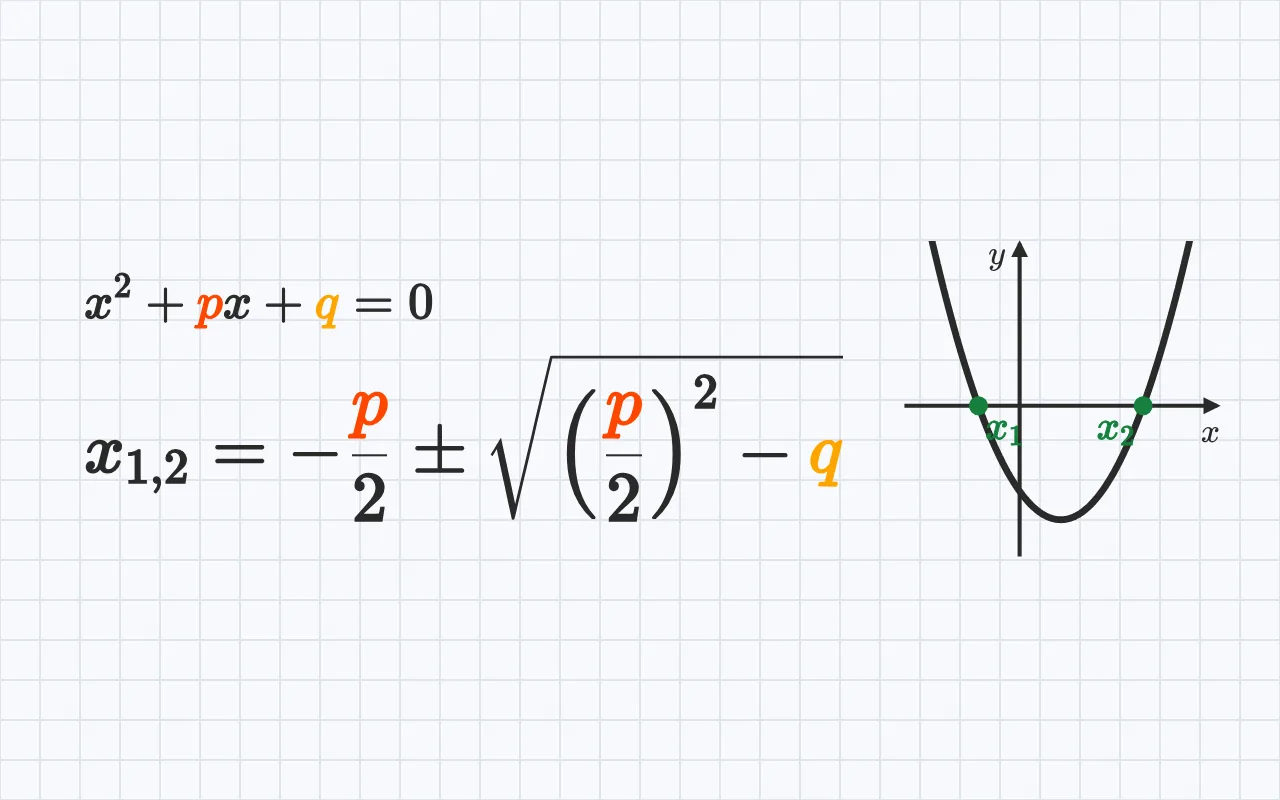
\( x^2 + px + q = 0 \) pq-Formel oder Mitternachtsformel
\( ax^2 + bx = 0 \) \(x\) ausklammern
\( ax^2 + c = 0 \) umstellen, Wurzel ziehen
\( ax^4 + bx^2 + c = 0 \) erst substituieren, dann Mitternachtsformel

Ist \( a = 1 \), kannst du genauso gut die pq-Formel nehmen. Beide Formeln liefern dieselben Lösungen. Steht vor dem \(x^2\) eine andere Zahl, müsstest du für die pq-Formel erst die ganze Gleichung durch \(a\) teilen. Dann ist \( p = \frac{b}{a} \) und \( q = \frac{c}{a} \).

\( 2x^2 - 8x + 6 = 0 \quad \big|\, :2 \)
\( x^2 - 4x + 3 = 0 \)
\( p = -4 \qquad q = 3 \)

Mit Brüchen wie \( \frac{5}{3} \) rechnet es sich unbequem. Lässt sich die Gleichung nicht glatt durch \(a\) teilen, bleibst du deshalb besser bei der Mitternachtsformel.

Fehlt die Zahl ohne \(x\), ist also \(c = 0\), klammerst du \(x\) aus. Ein Produkt ist genau dann \(0\), wenn einer der Faktoren \(0\) ist:

\( 3x^2 - 12x = 0 \)
\( x \cdot (3x - 12) = 0 \)
\( x_1 = 0 \qquad x_2 = 4 \)

Kommt nur \(x^2\) vor und kein einfaches \(x\), ist also \(b = 0\), stellst du nach \(x^2\) um und ziehst die Wurzel. Denk an beide Vorzeichen:

\( 2x^2 - 18 = 0 \)
\( x^2 = 9 \)
\( x_1 = 3 \qquad x_2 = -3 \)

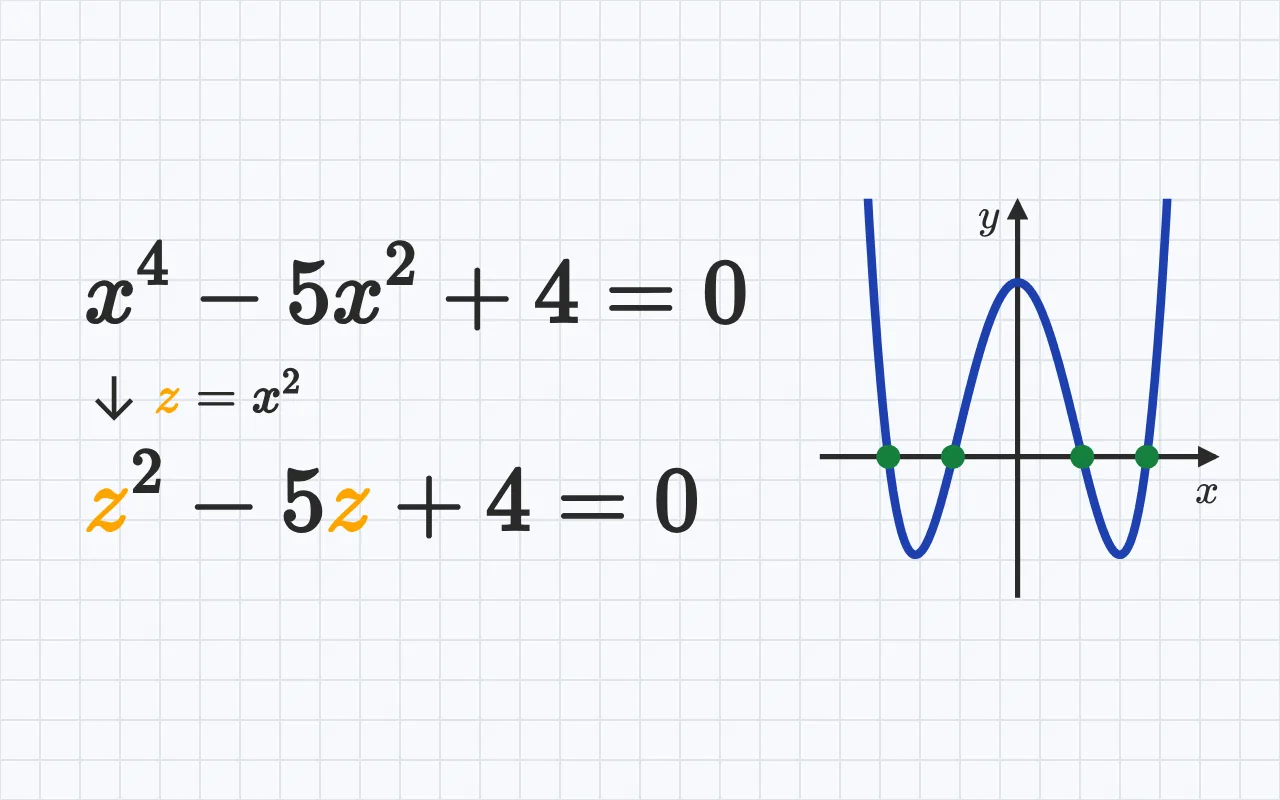
Bei Gleichungen wie \( x^4 - 5x^2 + 4 = 0 \) ersetzt du \(x^2\) durch \(z\). So entsteht eine quadratische Gleichung, die du mit der Mitternachtsformel löst:

\( z^2 - 5z + 4 = 0 \)
\( z_1 = 4 \qquad z_2 = 1 \)
\( x_{1,2} = \pm 2 \qquad x_{3,4} = \pm 1 \)

Zum Schluss ziehst du aus \(z_1\) und \(z_2\) die Wurzel. So bekommst du vier Lösungen für \(x\).