
Rechnen im rechtwinkligen Dreieck
Satz des Pythagoras

Pythagoras in 20 Sekunden
Mit dem Satz des Pythagoras kannst du in einem rechtwinkligen Dreieck eine fehlende Seite berechnen. Wie das funktioniert, schauen wir uns direkt an zwei Beispielen an.
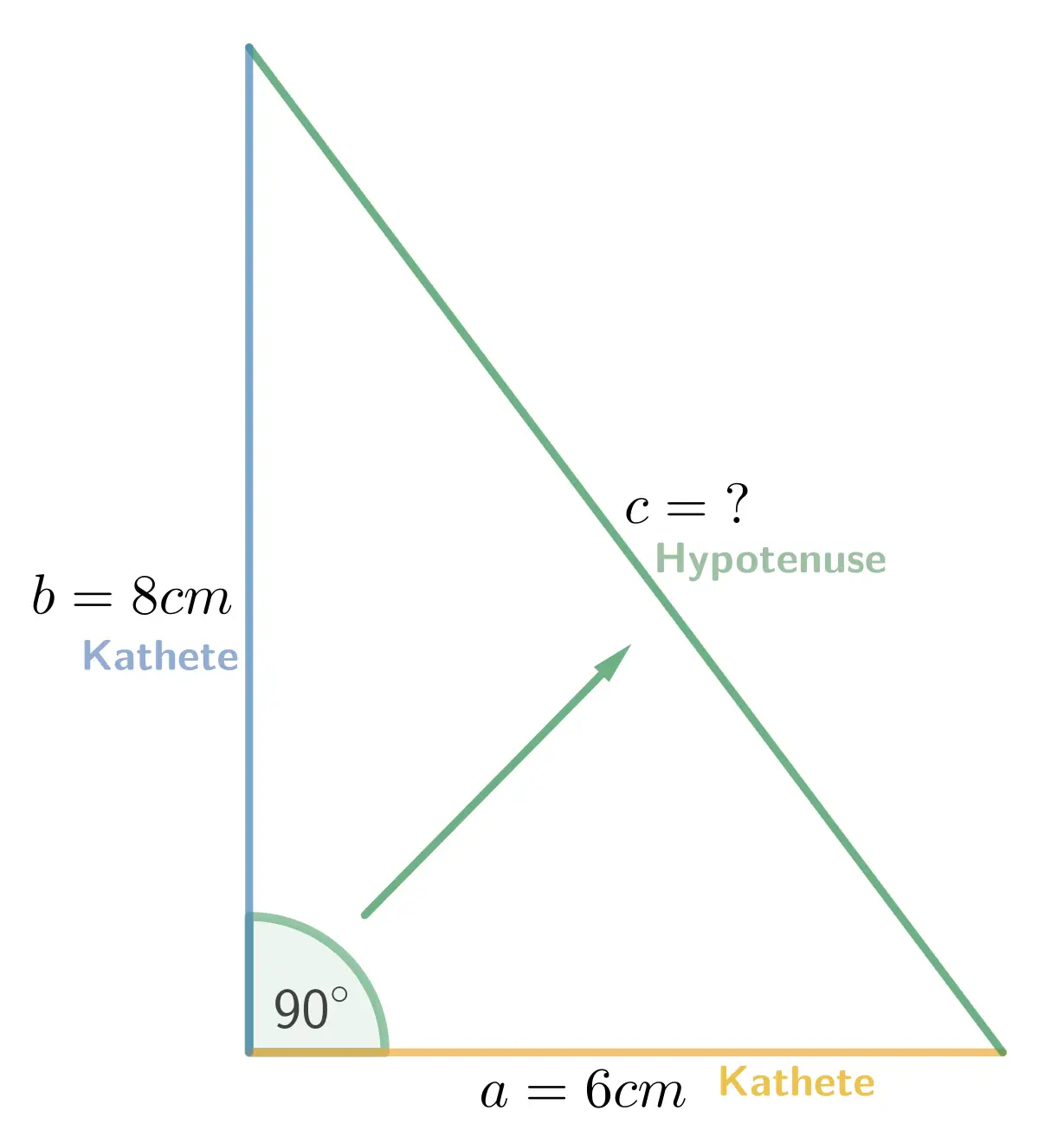
Gegeben sind die Kathete \({\textcolor{orange}{a=6\,\text{cm}}}\) und die Kathete \({\textcolor{steelblue}{b=8\,\text{cm}}}\). Gesucht ist die Hypotenuse \({\textcolor{green}{c}}\).
| \( {\textcolor{orange}{6}}^2 + {\textcolor{steelblue}{8}}^2 = {\textcolor{green}{c}}^2 \) | Seiten einsetzen | |
| \( 36+64={\textcolor{green}{c}}^2 \) | Quadrate berechnen | |
| \( 100={\textcolor{green}{c}}^2 \) | ausrechnen | |
| \( {\textcolor{green}{c}}=\sqrt{100} \) | Wurzel ziehen | |
| \( {\textcolor{green}{c}} = {\textcolor{green}{10\,\text{cm}}} \) | Ergebnis |
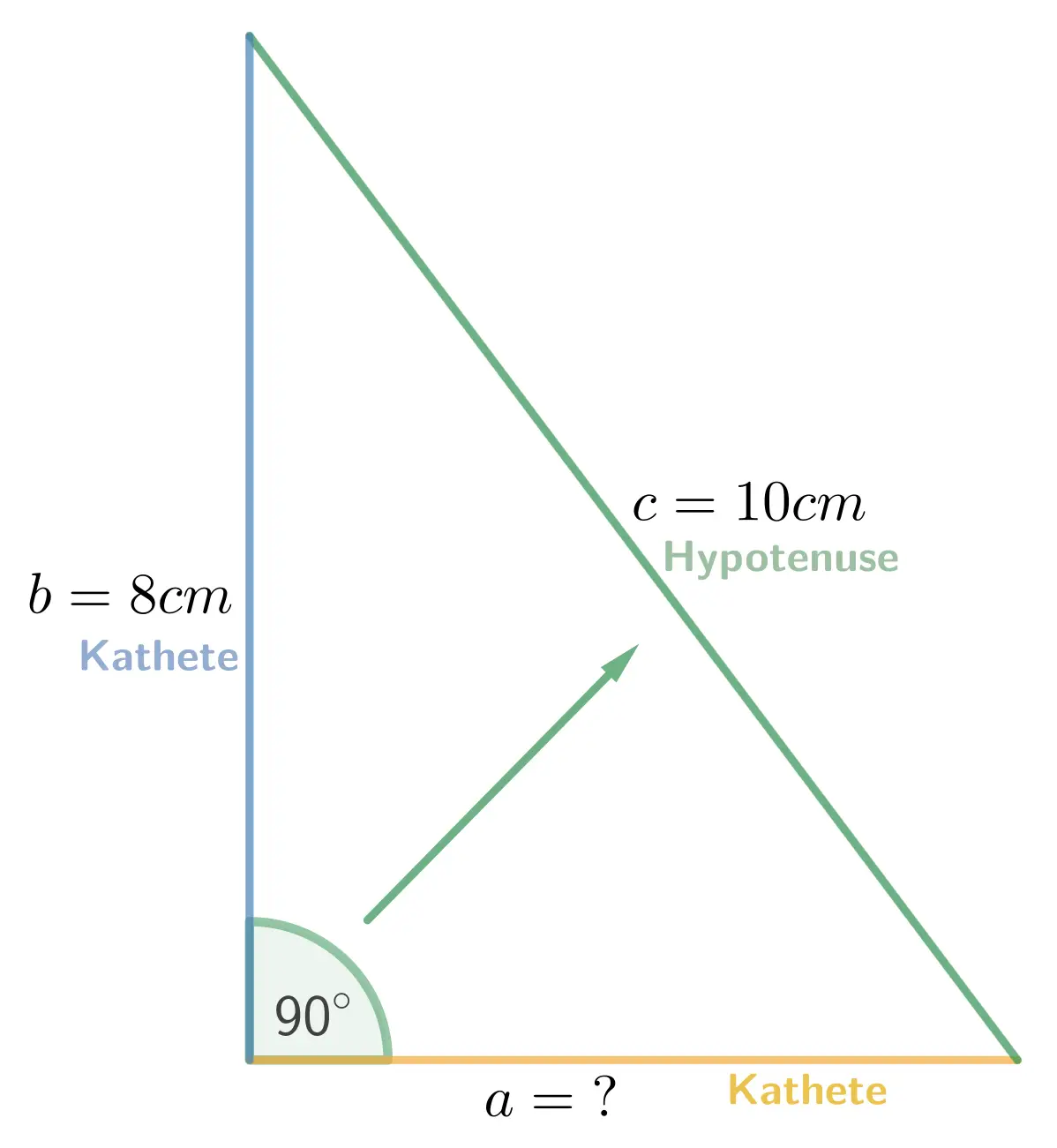
Gegeben sind die Kathete \({\textcolor{steelblue}{b=8\,\text{cm}}}\) und die Hypotenuse \({\textcolor{green}{c=10\,\text{cm}}}\). Gesucht ist die Kathete \({\textcolor{orange}{a}}\).
| \( {\textcolor{orange}{a}}^2 + {\textcolor{steelblue}{8}}^2 = {\textcolor{green}{10}}^2 \) | Seiten einsetzen | |
| \( {\textcolor{orange}{a}}^2+64=100 \) | Quadrate berechnen | |
| \( {\textcolor{orange}{a}}^2=100-64 \) | Kathete abziehen | |
| \( {\textcolor{orange}{a}}^2=36 \) | ausrechnen | |
| \( {\textcolor{orange}{a}}=\sqrt{36} \) | Wurzel ziehen | |
| \( {\textcolor{orange}{a}} = {\textcolor{orange}{6\,\text{cm}}} \) | Ergebnis |
Wenn du beide Rechenwege verstanden hast, kannst du den Satz des Pythagoras anwenden. Damit du dabei aber auch bei anderen Dreiecken sicher bist, solltest du noch ein paar grundlegende Regeln kennen.
Welche Seiten gehören in die Formel?
Der Satz des Pythagoras gilt nur in einem rechtwinkligen Dreieck. Dort haben die Seiten besondere Namen:
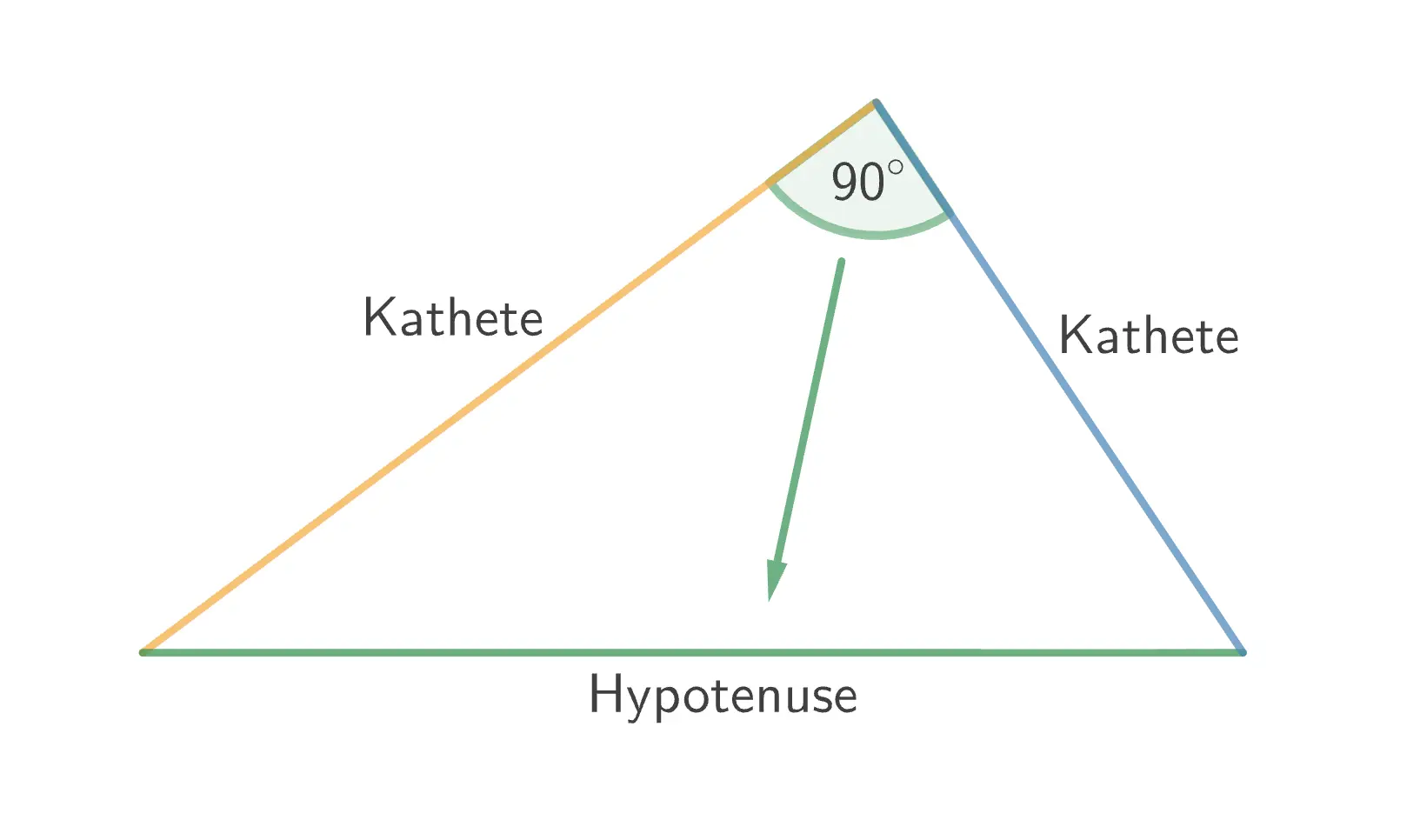
Die beiden Seiten, die sich am rechten Winkel treffen, heißen Katheten. Die Seite gegenüber vom rechten Winkel heißt Hypotenuse.
- Die Hypotenuse liegt gegenüber vom rechten Winkel.
- Die beiden Katheten treffen sich am rechten Winkel.
- Die beiden Katheten stehen in der Formel zusammen, die Hypotenuse steht allein.
Der Weg zur Lösung
Stolpersteine sehen und vermeiden
Anwendungsaufgabe
Bei Textaufgaben mit Pythagoras ist der wichtigste Schritt nicht die Rechnung, sondern das Übersetzen: Du musst erkennen, wo das rechtwinklige Dreieck steckt. Wir helfen dir dabei und geben dir ein Rezept an die Hand.
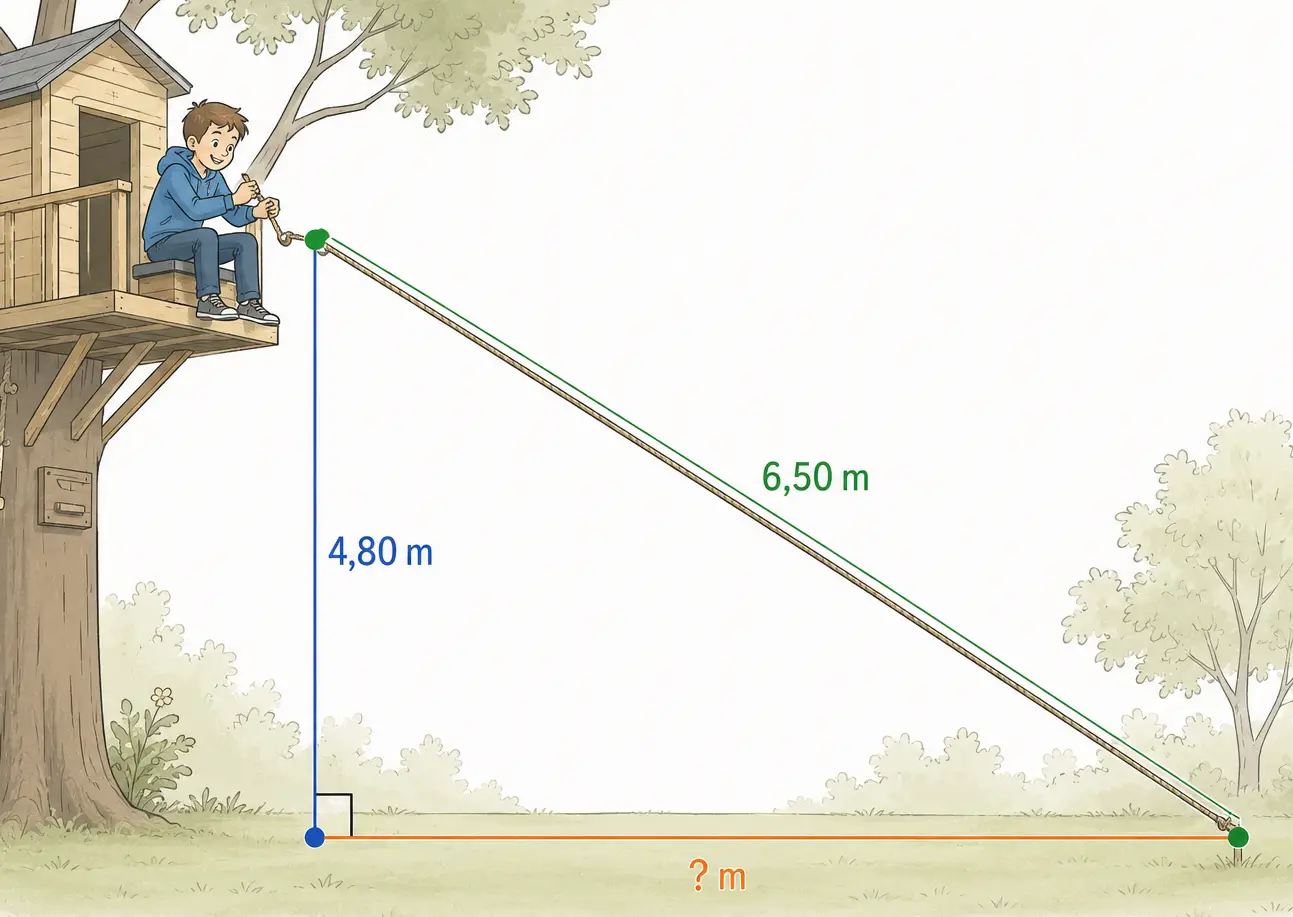
Finn möchte von seinem Baumhaus eine Seilrutsche bis zum Boden spannen. Die Plattform liegt 4,80 m über dem Boden. Für die Seilrutsche steht ein 6,50 m langes Seil zur Verfügung.
Wie weit vom Baumhaus entfernt endet die Seilrutsche?
Aus dem Text ein Dreieck machen
Bei der Seilrutschen-Aufgabe entsteht das rechtwinklige Dreieck aus Höhe des Baumhauses, Boden und Seilrutsche. Höhe und Boden bilden den rechten Winkel.
- Die Seilrutsche liegt gegenüber vom rechten Winkel. Deshalb ist sie die Hypotenuse.
- Die Höhe der Plattform verläuft senkrecht zum Boden. Sie ist eine Kathete.
- Der Abstand vom Baumhaus liegt am Boden. Er ist die gesuchte Kathete.
Zahlen richtig einsetzen
Jetzt bekommt jede Seite ihren Buchstaben. Wir wählen die Seilrutsche als \( {\textcolor{green}{c}} \), die Höhe der Plattform als \( {\textcolor{steelblue}{b}} \) und den gesuchten Abstand als \( {\textcolor{orange}{a}} \).
- Seilrutsche: \( {\textcolor{green}{c}} = {\textcolor{green}{6,50\,\text{m}}} \)
- Höhe der Plattform: \( {\textcolor{steelblue}{b}} = {\textcolor{steelblue}{4,80\,\text{m}}} \)
- Abstand vom Baumhaus: \( {\textcolor{orange}{a}} \) gesucht
Wichtig: Die Seilrutsche liegt gegenüber vom rechten Winkel und ist deshalb die Hypotenuse. Darum steht ihre Länge später auf der rechten Seite der Pythagoras-Formel.
Formel aufstellen und einsetzen
| \( {\textcolor{orange}{\text{Abstand}}}^2 + {\textcolor{steelblue}{\text{Höhe}}}^2 = {\textcolor{green}{\text{Seilrutsche}}}^2 \) | in Worten | |
| \( {\textcolor{orange}{a}}^2 + {\textcolor{steelblue}{b}}^2 = {\textcolor{green}{c}}^2 \) | mit Buchstaben | |
| \( {\textcolor{orange}{a}}^2 + {\textcolor{steelblue}{4,80}}^2 = {\textcolor{green}{6,50}}^2 \) | einsetzen |
Abstand vom Baumhaus berechnen
| \( {\textcolor{orange}{a}}^2 + {\textcolor{steelblue}{4,80}}^2 = {\textcolor{green}{6,50}}^2 \) | ||
| \( {\textcolor{orange}{a}}^2 + 23,04 = 42,25 \) | quadrieren | |
| \( {\textcolor{orange}{a}}^2 = 42,25 - 23,04 \) | \( -23,04 \) |
Die bekannte Kathete wird auf beiden Seiten abgezogen. Dadurch entsteht beim Umstellen das Minus.
| \( {\textcolor{orange}{a}}^2 = 19,21 \) | ausrechnen | |
| \( {\textcolor{orange}{a}} = \sqrt{19,21} \) | Wurzel ziehen |
Gesucht ist \( {\textcolor{orange}{a}} \), nicht \( {\textcolor{orange}{a}}^2 \). Deshalb ziehen wir am Ende die Wurzel.
| \( {\textcolor{orange}{a}} \approx {\textcolor{orange}{4,38}} \) | Ergebnis |
So löst du Pythagoras-Textaufgaben
- Erkenne: Gibt es ein rechtwinkliges Dreieck?
- Ordne zu: Was ist die Hypotenuse, was sind die Katheten?
- Überlege: Was ist gesucht?
- Entscheide: Suchst du die Hypotenuse oder eine Kathete?
- Erst dann stellst du die passende Gleichung auf.
Rechnen mit Einheiten
Mathe macht Druck? Wir bringen Struktur.
Echtes Verständnis ab der ersten Stunde.


Mehr dazu
Weiterführende Informationen
Ist mein Dreieck rechtwinklig?
Warum nur im rechtwinkligen Dreieck?